Long range
Up to 15 km line-of-sight in rural areas, 2–5 km in dense urban zones. One gateway covers an entire greenhouse complex or grain elevator.
Long range, ultra-low power, license-free and secure. LoRaWAN connects thousands of sensors across a farm, factory or city — with one gateway and a single battery that lasts for years.
A LoRaWAN network is a star-of-stars topology: end-devices speak to one or more gateways over the LoRa radio modulation; gateways forward packets over IP to a network server, which delivers them to your application.
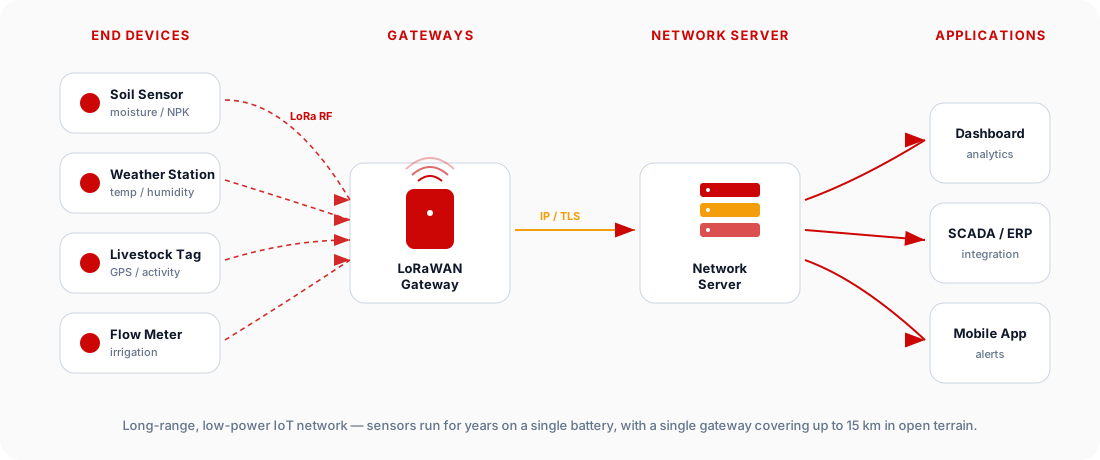
Up to 15 km line-of-sight in rural areas, 2–5 km in dense urban zones. One gateway covers an entire greenhouse complex or grain elevator.
Sensors transmit milliseconds at a time and sleep the rest. A single AA-class battery powers a soil probe for 5–10 years.
Operates on ISM bands (868 MHz EU, 915 MHz US, 433 MHz APAC). No SIM cards, no carrier fees, no spectrum auctions.
AES-128 encryption with separate network and application session keys — a gateway can’t read your payloads.
A single gateway handles thousands of nodes. Dynamic data rates and adaptive power keep the network efficient as it grows.
Maintained by the LoRa Alliance. Interoperable across gateways, network servers (TTN, ChirpStack, Loriot, AWS IoT Core) and devices.
LoRaWAN defines three end-device classes that trade battery life for downlink latency. EcoMetrik Systems supplies all three — matched to your application.
Lowest power. The device transmits when it has data; the network can reply for a short window after each uplink.
Use for: battery-powered field sensors, livestock tags, weather stations.
Scheduled downlinks. The device wakes at predictable beacon intervals to receive commands — useful for actuators that need timely instructions.
Use for: irrigation valves, ventilation flaps, scheduled control loops.
Always listening. Continuous receive window for instant commands — trades battery life, so typically mains-powered.
Use for: industrial controllers, mains-powered actuators, alarm panels.
Soil moisture sensors trigger valve actuators directly through the network server — water only when and where the crop actually needs it.
Agriculture solutions →Temperature and door-state sensors across a warehouse, with multi-year battery life and tamper-proof timestamped logs.
Food & beverage →Gas-leak detectors, valve-position sensors and lone-worker beacons covering an entire refinery or process plant from a few rooftop gateways.
Process industries →LoRa is a chirp-spread-spectrum modulation by Semtech. LoRaWAN is the open MAC layer on top, defined by the LoRa Alliance.